

Environmental Toxicology
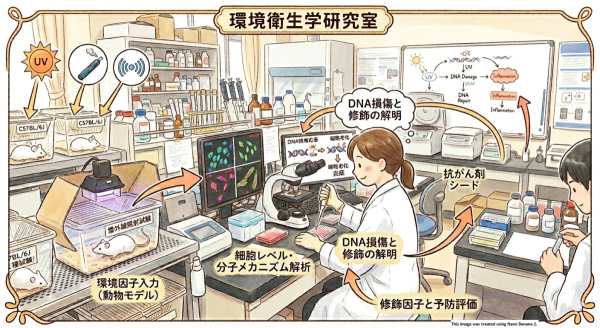
Research Overview
Our laboratory conducts advanced research across the following six key themes. These projects are driven by a core team of three faculty members and postdoctoral researchers, working in close collaboration with undergraduate students.
1. Safety Assessment of Intermediate Frequency Magnetic Fields
We investigate the potential for "non-thermal effects" (such as carcinogenicity and oxidative stress) resulting from exposure to electromagnetic fields at levels below standard safety guidelines. Our current focus is on analyzing the impact of fetal exposure on neurodevelopment and behavior using mouse models.
2. Development of Anti-cancer Drugs Targeting DNA Damage Response
We are searching for compounds that specifically inhibit the resumption of cell division following DNA damage caused by UV radiation or other factors. This research aims to establish new therapeutic strategies for treatment-resistant cancers, enhance the efficacy of existing drugs, and reduce clinical side effects.
3. Anti-inflammatory Effects of Essential Oil Components
We identify essential oil components that suppress the activation of microglia (immune cells in the brain). With the goal of developing treatments or preventative measures for neurodegenerative diseases and refractory depression associated with chronic inflammation, we are currently validating these effects in animal models.
4. Toxicity Evaluation of Heated Tobacco Products (HTPs)
In collaboration with the National Institute of Public Health, we are evaluating the toxicity of increasingly popular heated tobacco products. Through exposure experiments using mouse models, we perform detailed histological analyses of the liver and various other organs to clarify their biological impact.
5. Novel Functional Analysis of Estrogen Receptor Alpha (ERα) Phosphorylation
This research focuses on the phosphorylation of ERα within immune cells. By utilizing knock-in mice, we aim to uncover novel physiological functions triggered by phosphorylation at specific sites (such as Ser216), particularly focusing on their involvement in inflammatory response mechanisms.
6. Development of Novel Anti-thrombotic Agents Derived from Snake Venom Peptides
Using highly substrate-specific peptides found in snake venom as lead compounds, we are engaged in collaborative research to create novel platelet aggregation inhibitors (anti-thrombotic drugs). Our objective is to develop highly effective treatments with minimal side effects.
Members
-
 HATTORI KENJI Professor
 -
 OHYAMA ETSUKO Lecturer
 -
SHINDOU SAWAKO Lecturer